

Satoshi Institute hero background – Bitcoin treasury education
Treasury v2 Defensibility

Is Your Bitcoin Treasury Strategy Still Defensible?

Satoshi Institute helps boards, CFOs, investors, and Bitcoin treasury companies evaluate treasury policy, liquidity readiness, capital structure pressure, and sell-decision governance.

Treasury Policy
Liquidity Readiness
Capital Structure Pressure
Sell-Decision Governance

Pre-scoped · 5–7 page memo · $2,500–$5,000

Board-level governancefor corporate Bitcoin treasury.

Capital-structure discipline and stress-tested oversight for CFOs, audit committees, and boards.

Four governance frameworks replace intuition with process. RAES decides what's eligible. RARTA decides when and how much. SRF tells you what to do when things break. BEOL optimizes what you already hold.

For CFOs & Treasury Directors

Request a Confidential Diagnostic
SatoshiAnalytics.org

Bitcoin Treasury
Intelligence Platform

Track every public company holding Bitcoin. Proprietary scoring models evaluate financial capacity, strategic positioning, and organizational readiness for treasury adoption.

PBTI & GVI Indices — Real-time composite scoring of treasury-holding companies
Readiness Analytics — Identify which companies are most likely to adopt Bitcoin next
Institutional-Grade Data — Holdings, market caps, and governance metrics updated daily

Live Market Intelligence

BTC Price

$0

24h Change

0%

Public Co. Holdings

0M BTC

US Companies

0

Market Cap

$0T

Dominance

0%

Circulating Supply

0M

Hashrate

0 EH/s

Jun 29, 2026, 8:12 PM

Find the moment you're in

Five moments that bring CFOs and boards to Treasury v2.

Most engagements start the same way: a specific governance gap surfaces under a specific kind of pressure. If one of these is yours, the rest of the site is organized around it.

  1. Moment 01

    The board question you couldn't document

    An independent director asks how the allocation was sized. The answer exists in a CFO's head, an email thread, and a deck — but not in a signed, dated decision record the auditor can pull next quarter.

    Addressed by RARTA
  2. Moment 02

    The position that outgrew its approval

    The board approved a 1% allocation. Price appreciation made it 6% of the balance sheet. Nothing in the original mandate tells the committee whether to rebalance, hold, or re-approve — and the next 10-Q is six weeks out.

    Addressed by RARTA
  3. Moment 03

    The drawdown that exposed a missing protocol

    A 38% drawdown lands on a Friday. The treasury team has no pre-committed response taxonomy, no escalation authority chart, and no hour-by-hour playbook. The decisions get made anyway — without a defensible audit trail.

    Addressed by SRF
  4. Moment 04

    The diligence that surfaced a governance gap

    An acquirer's diligence team asks for the treasury policy, the custody architecture rationale, the tax-lot methodology, and the sell-decision governance memo. Three of the four don't exist as standalone documents.

    Addressed by BEOL
  5. Moment 05

    The asset request the committee can't adjudicate

    A founder, a vendor, or a peer company pushes a non-Bitcoin reserve asset onto the agenda. The risk committee has no written eligibility test to apply — so the question becomes a debate instead of a documented decision.

    Addressed by RAES

None of the five fit cleanly? A 30-minute confidential review identifies which governance layer is unguarded.

Market Pulse

BTC Price

$60,377

24h Change

+1.40%

Public Co. Holdings

0.82M BTC

US Companies

36

Market Cap

$1.21T

Dominance

55.6%

Treasury v1 → Treasury v2

The shift from conviction to governance.

Accumulation as strategy.

Governance as strategy.

Buy and hold.

Buy, govern, and survive.

One person decides.

A framework decides.

Improvised stress response.

Pre-committed drawdown protocols.

Audit finds gaps.

Audit finds process.

Board tolerates Bitcoin.

Board governs Bitcoin.

The intellectual spine

Treasury v2 is a governance discipline, not a thesis.

Treasury v1 asked should we hold Bitcoin? Treasury v2 asks the four questions a board has to answer in writing, in this order, before the position is defensible: what is eligible, how much, what happens under stress, and how we operate it. The Institute publishes the governance layer of each — the concepts, definitions, and structure — as public reference. The operational artifacts, calibrated thresholds, and signed adjudication memoranda live inside engagement.

RAES

Reserve Asset Eligibility Standard

What is eligible to sit on the balance sheet?

A written, seven-criteria adjudication test that turns reserve-asset debates into signed, dated decisions. Bitcoin clears. Most non-Bitcoin proposals do not — but the test is what defends that conclusion to the board.

Read the RAES concept layer
RARTA

Risk-Aligned Return Threshold Approach

How much, when, and under whose authority?

Sizing, timing, and threshold triggers are derived from a stated risk appetite — not from market sentiment. Allocation decisions and rebalancing events are logged at the moment they are made, with the rationale attached.

Read the RARTA concept layer

SRF

Stress Response Framework

What happens when the price moves against us?

A four-level stress taxonomy with pre-committed actions, escalation authority, and an hour-by-hour playbook. Crisis decisions are made in advance, so the actual event is execution — not improvisation.

Read the SRF concept layer

BEOL

Bitcoin Economic Optimization Logic

How do we operate what we already hold?

Custody architecture, accounting elections, tax-lot methodology, and counterparty constraints handled inside the policy envelope set above. Operational decisions become reproducible, not personality-dependent.

Read the BEOL concept layer

Public layer

Concept definitions, structural diagrams, and the published standards index. Built so a CFO doing diligence on the Institute can see the architecture — and so an audit committee can cite the framework by version in board minutes.

Gated operational layer

Calibrated thresholds, decision logs, signed adjudication memoranda, charters, and policy templates are produced inside engagement. The form is public; the calibration is the work.

Request a Confidential Diagnostic

The Framework Stack

Every Bitcoin treasury decision maps to one of four governance layers.

RARTA

Systematic allocation decision logic.

Typical Artifacts

  • Allocation Decision Log
  • Risk-Tolerance Calibration Matrix
  • Board Approval Trigger Table
CFO / Treasury Committee

SRF

Pre-committed stress response protocols.

Typical Artifacts

  • 4-Level Stress Taxonomy
  • Hour-by-Hour Drawdown Playbook
  • Escalation Authority Chart
Risk Committee / Board

BEOL

Constraint-aware operational optimization.

Typical Artifacts

  • Accounting Decision Calculator
  • Custody Architecture Selector
  • Tax-Lot Optimization Worksheet
Treasury Operations / Finance

RAES

Reserve asset eligibility adjudication.

Typical Artifacts

  • Seven-Criteria Adjudication Test
  • Asset Eligibility Scorecard
  • Board Adjudication Memorandum
Board / Risk Committee
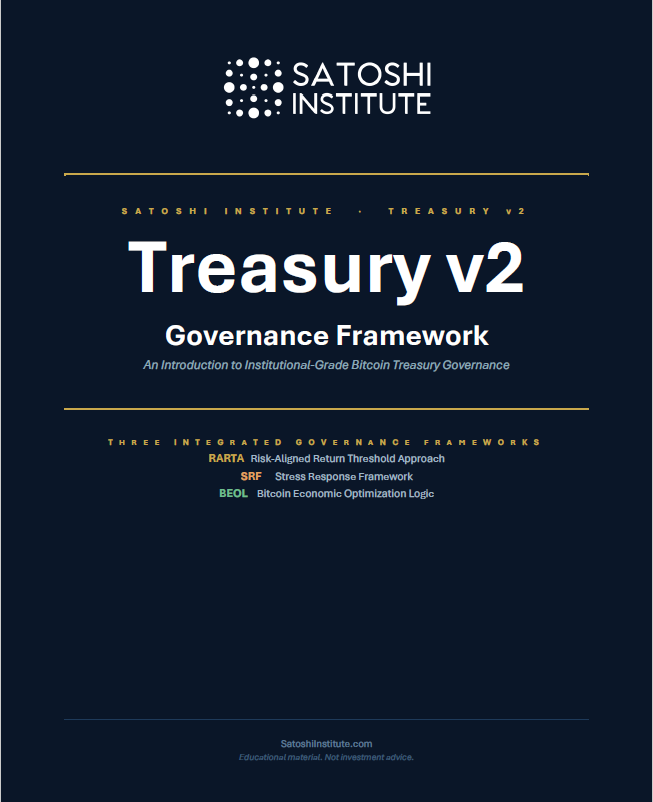
Treasury v2 Framework Overview cover

Free Download

Treasury v2 Framework Overview

A comprehensive summary of all four governance frameworks — RARTA, SRF, BEOL, and RAES — and how they integrate into a single operating system for Bitcoin treasury management.

Covers allocation logic, stress response protocols, operational constraints, and the layer hierarchy that defines how frameworks interact under normal and crisis conditions.

Learn more

How It Runs

A four-layer governance model. Each layer constrains the one below it.

Policy Layer

Board-approved allocation mandate, risk appetite, and governance charter.

Strategy Layer

RARTA calibrates sizing, timing, and threshold triggers within policy bounds.

Crisis Layer

SRF activates pre-committed responses when drawdowns breach defined levels.

Optimization Layer

BEOL manages custody, accounting, and tax-lot decisions within all constraints above.

Standards, Not Opinions

Satoshi Institute publishes governance standards. Every framework follows a transparent development process.

Published Standards

Frameworks are published as versioned standards. Each version is dated, scoped, and subject to quarterly calibration reviews.

Semantic Versioning

Major versions indicate structural changes. Minor versions reflect calibration updates. Every change is logged.

Peer Review

Practitioners, auditors, and governance professionals review drafts before promotion. No framework ships without scrutiny.

Signals

A daily governance intelligence feed. Market events interpreted through RARTA, SRF, and BEOL—not price commentary. What happened. What it triggers. What to document.

Delivered once daily. No hype. No calls to action. Just signal.

Governance readiness, in writing

Treasury v2 Policy Checklist

The board-ready checklist CFOs and audit committees use to pressure-test allocation authority, drawdown protocols, custody architecture, and disclosure posture before the next meeting.

Company email required · No sales call triggered

When the position is already real

Request a Confidential Diagnostic

A board-ready treasury review: allocation authority, stress protocols, custody architecture, and disclosure posture — conducted under NDA with finance leadership.

Request a Confidential Diagnostic

Confidential · NDA on request · Executive-level