
Strive Bought 1,355 BTC. The Bigger Story Is What Happened Per Share.
Strive Bought 1,355 BTC. The Bigger Story Is What Happened Per Share.
Daily Setup / Perspective
Strive is having its moment.
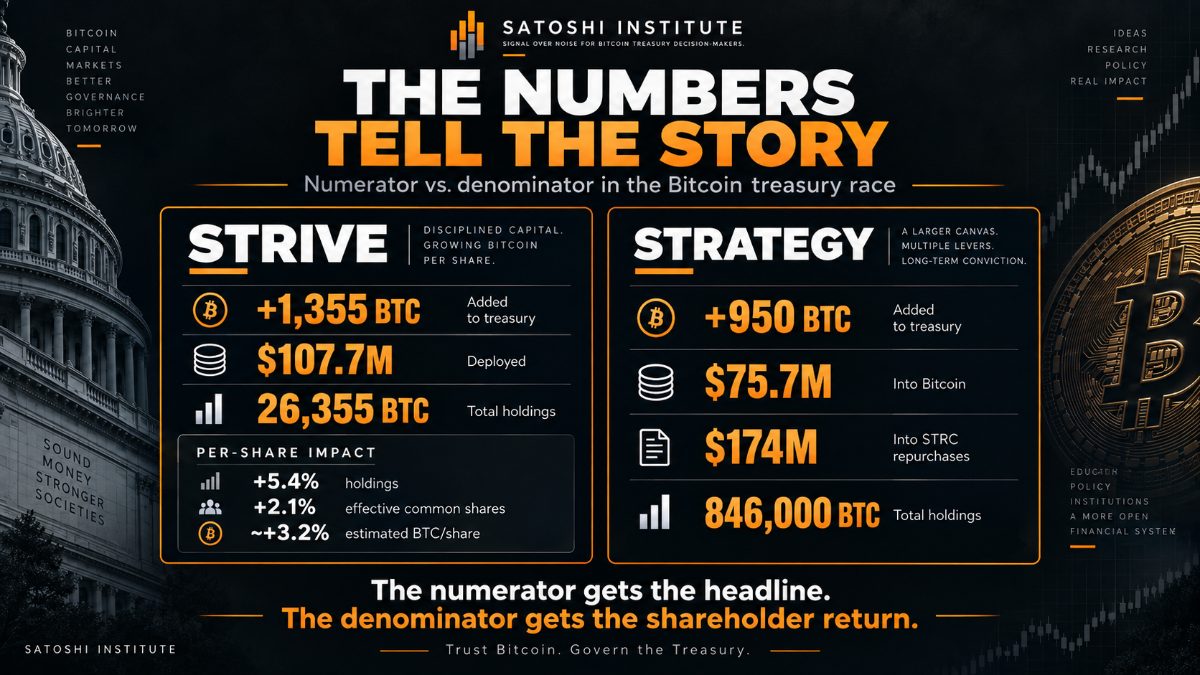
The company purchased another 1,355 BTC for approximately $107.7 million, at an average price of about $79,475 per BTC, taking total holdings to 26,355 BTC. SEC
That is the headline. But the more interesting number is not the 1,355 BTC. It is what happened to the denominator.
During the same period, Strive’s effective common share count increased by roughly 2.1%, while Bitcoin holdings increased by about 5.4%. One filing-based analysis estimates BTC per share improved by approximately 3.2%. BTCperShare
That is what Treasury v2 is supposed to measure. Not simply whether the company bought Bitcoin. Whether the shareholder actually received more Bitcoin exposure.
The Day’s Signals
1. Strive adds 1,355 BTC
Strive reportedly purchased 1,355 BTC for approximately $107.7 million at an average price of $79,475 per BTC, bringing total holdings to 26,355 BTC. SEC
That makes Strive one of the larger public-company Bitcoin holders. But the company is also becoming an increasingly interesting test case for a different reason.
It is combining:
- preferred capital,
- warrant exercises,
- common equity,
- and Bitcoin accumulation
- inside one rapidly evolving capital structure.
2. BTC/share improved, but the denominator is moving
Strive’s Bitcoin holdings increased approximately 5.4%, while effective common shares increased roughly 2.1%.
That translates into an estimated improvement in BTC per share of approximately 3.2%. BTCperShare
That is exactly the kind of disclosure investors should demand. Because a treasury can grow dramatically while the shareholder economics barely move. This time, the numerator grew faster.
Next time, it may not.
3. The market is now adding leverage on top of the treasury wrapper
REX Shares has launched ASSX, a leveraged ETF designed to provide 2x the daily performance of Strive common stock. The fund explicitly targets daily results and warns that it is not designed to deliver 2x performance over longer holding periods. REX Shares
Think about the layers now:
- Bitcoin.
- Inside Strive.
- Inside a capital structure containing preferreds and warrants.
- Inside a leveraged ETF.
That is a long way from simply owning Bitcoin.
4. Strategy buys 950 BTC, but spends more than twice as much on STRC
Strategy purchased another 950 BTC for approximately $75.7 million at an average price near $79,670, bringing total holdings back to 846,000 BTC. The Block
But during the same period, Strategy spent $174 million repurchasing STRC preferred stock. SEC
That means Strategy devoted more than twice as much cash to managing one piece of its capital structure as it did to buying Bitcoin.
That is significant.
5. Strive and Strategy now show two versions of the same model
Strive is still in aggressive expansion mode.
Strategy is increasingly in capital-management mode.
Both bought Bitcoin last week.
But their decisions tell different stories.
Strive: +1,355 BTC
Strategy: +950 BTC
Yet Strategy also used $174 million to repurchase STRC, while Strive continues to build its financing architecture around preferreds and warrants. The Block
What This Actually Means
The treasury market is moving from a race for absolute Bitcoin holdings to a competition over per-share economics.
Strive’s latest purchase is interesting precisely because both sides of the equation moved. Bitcoin holdings increased. The share count increased too. The question is which moved faster. That is the institutional standard the sector needs.
Strategy reinforces the same point from another direction. It bought Bitcoin, but also spent substantially more money managing its preferred securities. That suggests the Bitcoin treasury model is becoming less about one-way accumulation and more about continuous capital allocation.
The best treasury will not necessarily be the company that buys the most Bitcoin every week.
It may be the company that can demonstrate, repeatedly, that every capital decision improves the durability of shareholder economics. That is a much harder standard. It is also a much better one.