
Cheap money built the treasury trade. Expensive money is testing it.
Cheap money built the treasury trade. Expensive money is testing it.
Daily Perspective
Bitcoin treasury companies spent the last several years optimizing for one environment: abundant capital, rising asset prices, and investors willing to finance accumulation.
That environment is getting less cooperative.
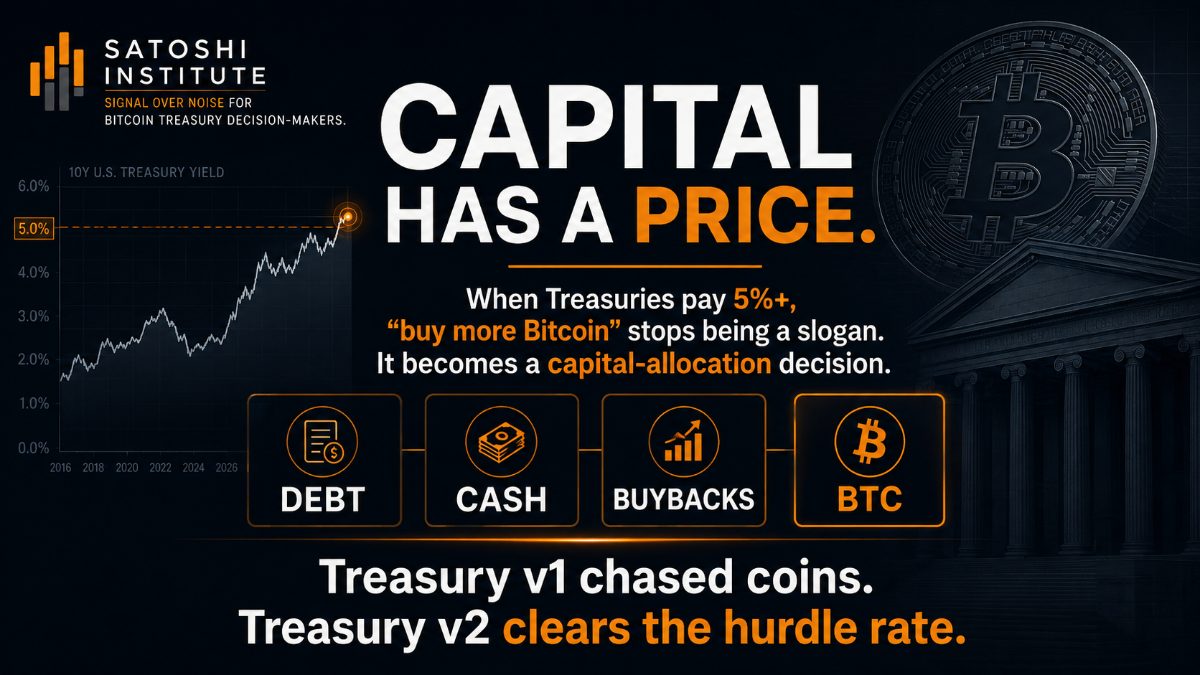
Long-term Treasury yields are above 5%. Crypto-backed credit has contracted sharply from its 2025 peak. Strategy is raising cash without adding Bitcoin. Nakamoto sold BTC to reduce debt and still faces a meaningful maturity. Meanwhile, Metaplanet is doing the opposite, committing 2,100 BTC to create a new U.S. treasury platform.
Apparently there are now two Bitcoin treasury strategies. One is conserving optionality. The other is manufacturing more of the structure. That should make the next few quarters educational.
Signals We’re Watching
5.3% changes the hurdle rate
The U.S. 30-year Treasury yield crossed roughly 5.3%, its highest level since 2007 according to the reports you supplied. At the same time, crypto-collateralized lending has reportedly fallen by about $22.5 billion from its 2025 peak.
That combination matters more to treasury companies than Bitcoin's daily price.
When investors can earn more than 5% from long-duration government debt, speculative capital has a much higher hurdle to clear. Debt becomes more expensive. Equity investors demand more compensation. Refinancing becomes less forgiving.
Bitcoin may still have enormous upside.
But "Bitcoin will probably appreciate" competes poorly with a liability that definitely comes due.
Nakamoto shows what deleveraging actually looks like
Nakamoto reportedly sold 600 BTC to reduce a USDT loan from roughly $210 million to $165 million.
That sounds like progress.
Except the company still reportedly has about $60 million due in December, while much of the remaining Bitcoin remains pledged as collateral.
This is why gross BTC holdings are such a poor measure of treasury strength.
The relevant number is the Bitcoin left after creditors have opinions.
Selling BTC to reduce leverage may be perfectly rational. The governance problem appears when shareholders cannot tell how much collateral remains encumbered, what triggers additional repayment, and which obligation gets funded next.
Strategy is choosing cash over another purchase
Strategy reportedly sold about $334 million of common equity while leaving its Bitcoin holdings unchanged. The proceeds were directed toward preferred dividends, repurchases of digital-credit securities, and the USD reserve.
That is a significant evolution from the original accumulation flywheel.
Management now has several competing uses for every dollar raised:
Buy BTC.
Support preferred obligations.
Repurchase securities.
Maintain cash.
The existence of those choices is not weakness. It is what happens when a Bitcoin treasury becomes a capital structure.
The interesting question is whether investors still value the structure the same way when accumulation is no longer the automatic answer.
Metaplanet is exporting the treasury model
Metaplanet plans to contribute 2,100 BTC and cash into Super League, acquiring roughly 96% and transforming the Nasdaq-listed company into "Superplanet," a U.S. Bitcoin treasury platform.
That is one of today's more revealing developments.
Instead of merely accumulating BTC inside one public company, Metaplanet appears to be using Bitcoin itself to seed another corporate treasury vehicle.
If the new platform then uses its Bitcoin as collateral for preferred securities or other financing, Bitcoin becomes more than the treasury asset.
It becomes the raw material for manufacturing another layer of corporate claims.
That can create capital efficiency.
It can also create complexity very quickly.
What This Actually Means
The treasury trade is entering a more expensive financial world. When capital was cheap, adding leverage could accelerate Bitcoin accumulation. When government bonds yield more than 5%, every financing decision gets harder.
Debt costs more.
Equity investors demand more.
Cash becomes valuable again.
And Bitcoin purchases have to compete with liabilities that already exist.
That is why Strategy can raise capital and not buy BTC. It is why Nakamoto can sell BTC without abandoning Bitcoin. And it is why Metaplanet's U.S. expansion deserves scrutiny beyond the headline 2,100 BTC.
The question is no longer whether Bitcoin is a good asset. It is whether the corporate structure around it can earn its cost of capital. That is a very different test.