
The treasury company is becoming an operating company again
The treasury company is becoming an operating company again
Daily Perspective
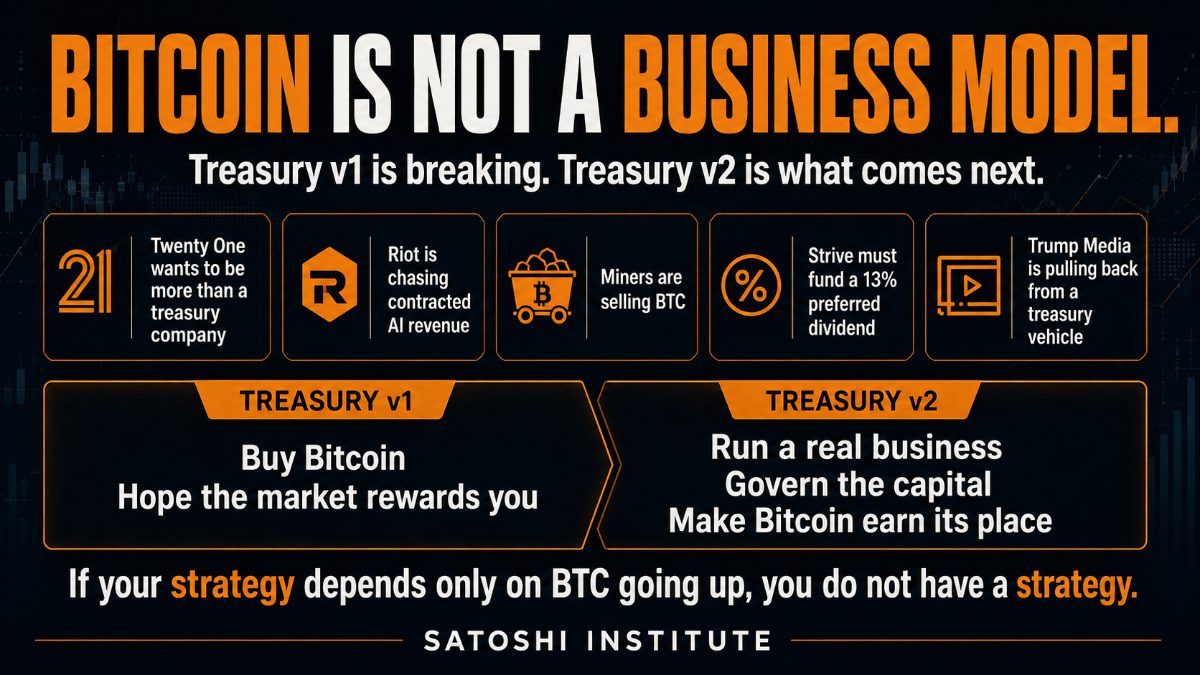
Twenty One says it wants to become "more than a treasury company."
Riot is locking in a multibillion-dollar AI infrastructure deal. Public miners have sold roughly 28,000 BTC this year. Trump Media is backing away from a separate crypto treasury vehicle. Strive is discovering that a 13% preferred dividend creates priorities that can compete directly with Bitcoin accumulation.
That is quite a change from "raise money, buy Bitcoin, repeat."
The companies that survive this cycle increasingly look less like Bitcoin wrappers and more like businesses that happen to own Bitcoin.
Funny how corporate finance eventually wanders back into the room.
Signals We’re Watching
Twenty One wants a business beyond the treasury
Twenty One’s new CEO is explicitly talking about becoming "more than a treasury company."
That language matters.
The original appeal of the model was that Bitcoin itself could become the corporate strategy. The market is now asking what the company does besides hold an asset investors can buy directly.
A large BTC balance may attract attention. It does not automatically justify a public-company premium.
The next test is operating purpose.
Riot may have found something more valuable than mining Bitcoin
Riot reportedly signed a 20-year AI infrastructure agreement valued around $9.1 billion. That is the kind of contract that changes capital allocation. Bitcoin mining produces volatile revenue tied to BTC price, network difficulty, transaction fees, and energy costs. A long-duration compute contract can turn the same power infrastructure into contracted cash flow.
This does not mean Bitcoin mining is obsolete.
It means miners are finally being forced to ask what their power assets are worth to someone other than Bitcoin. That is an operating-company question.
Public miners are selling Bitcoin while hash economics adjust
Public miners reportedly began the year holding roughly 127,000 BTC and now hold closer to 99,000 BTC. At the same time, declining hash rate has improved the economics for miners who remain active. That creates an interesting split.
Some miners are monetizing Bitcoin and infrastructure to pursue AI. Others may benefit from reduced competition and earn more BTC per unit of hash. There is no longer one obvious "Bitcoin miner strategy."
The asset allocation decision now includes Bitcoin, power, compute capacity, debt, and long-term contracted revenue.
Strive is learning that preferred capital has opinions
A 13% preferred dividend is not decorative. Preferred shareholders expect to be paid whether Bitcoin has a good quarter or a bad one. That creates a direct capital-allocation conflict:
- Should cash buy more BTC?
- Should it support preferred dividends?
- Should the company preserve liquidity?
- Should it repurchase discounted securities?
Once a treasury company issues high-yield preferred capital, the treasury cannot be governed as though common shareholders and Bitcoin accumulation are the only priorities.
The financing structure becomes part of the business.
Trump Media is pulling back from a separate crypto treasury vehicle
Trump Media reportedly terminated plans for a separate crypto treasury transaction while emphasizing its core operations.
That is another useful signal. The market once rewarded companies for adding a treasury story. Now management teams are having to explain why the treasury belongs inside the business at all. Walking away from a treasury transaction can be disciplined capital allocation if the operating case is weak.
Not adopting Bitcoin is also a treasury decision.
What This Actually Means
The first generation of Bitcoin treasury companies tried to make the asset the business. The next generation is being forced to make the business support the asset. That is a healthier model.
Twenty One needs an operating purpose. Riot can turn power infrastructure into contracted AI revenue. Miners are deciding whether BTC, compute, or liquidity offers the better return. Strive must balance accumulation against preferred obligations.
These companies are no longer managing a Bitcoin position in isolation. They are managing competing uses of capital. That is Treasury v2.
The question has shifted from:
"How much Bitcoin can we accumulate?"
to:
"What role does Bitcoin play inside a durable company?"
That distinction may determine which treasury companies remain relevant after the novelty wears off.