
Holding Forever Takes Cash
Holding Forever Takes Cash
Daily Setup / Perspective
Bitcoin treasury companies spent the last several years proving that they could raise capital and buy Bitcoin. The next phase is proving they can keep the Bitcoin while meeting everything else the corporation owes.
That distinction is becoming harder to ignore.
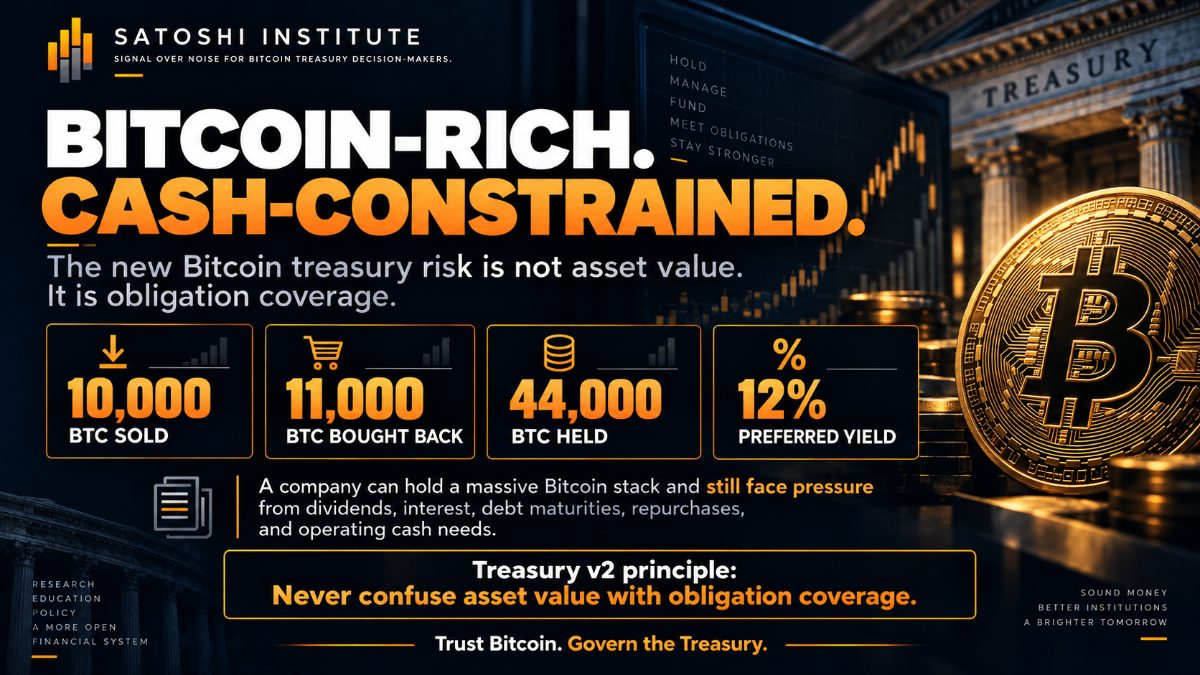
Metaplanet’s Q3 round-trip made the issue visible. The company sold 10,000 BTC, converted roughly $790 million into cash, and later repurchased 11,000 BTC for roughly $950 million. It finished the period with a net gain of 1,000 BTC and total holdings of 44,000 BTC.
The headline is that Metaplanet is now the second-largest public corporate Bitcoin holder.
The more important institutional lesson is simpler:
A large Bitcoin balance is not the same thing as liquidity.
Preferred dividends, interest, debt maturities, operating expenses, and repurchases are paid in cash. Bitcoin may ultimately fund those obligations, but the Treasury needs rules for how and when that conversion happens.
That is becoming one of the central Treasury v2 questions.
The Day’s Signals
1. Metaplanet demonstrated liquidity, but liquidity was not free
Metaplanet sold approximately 10,000 BTC near $79,000 and subsequently repurchased roughly 11,000 BTC near $86,000.
The company therefore ended with more Bitcoin than it started with, taking total holdings to approximately 44,000 BTC, but it also repurchased at a materially higher price.
The reaction has increasingly focused less on whether this was a good trade and more on why the transaction occurred.
The argument being made is that Metaplanet demonstrated something important to creditors and rating agencies: a large Bitcoin position can be monetized at scale when the company needs cash.
That may improve credit access.
But it also proves something Treasury v2 has emphasized from the beginning: liquidity has a cost.
2. “Never sell” runs into dividends, interest and corporate reality
The broader conversation is now shifting toward the cash requirements created by increasingly complicated treasury structures.
Strategy maintains substantial dollar reserves to cover preferred dividends, interest and other obligations.
Strive has expanded through SATA preferred financing.
Metaplanet is developing preferred and income-oriented strategies.
Smarter Web is launching a preferred security carrying an initial 12% annual distribution, reportedly paid weekly.
Those instruments can reduce dependence on common-share issuance. They do not eliminate the need for cash. A company can hold billions of dollars of Bitcoin and still face a cash-flow problem if its obligations come due in dollars.
3. Preferred stock solves one problem and creates another
Preferred financing is increasingly becoming the sector’s alternative to repeated common-equity dilution. That makes sense.
If companies can issue preferred securities near par, use the proceeds to acquire Bitcoin, and preserve more of the upside for common shareholders, the model can look attractive.
But a preferred share is still a claim. A 12% or 13% distribution eventually has to be funded. If operating income is insufficient and the company does not want to sell Bitcoin, the remaining choices may include issuing more securities, increasing leverage, or using reserves.
That is where the financing flywheel becomes more complicated.
4. Smarter Web is testing the preferred model in London
The Smarter Web Company reportedly raised approximately £10 million, with roughly £4 million expected to support additional Bitcoin purchases. Its preferred shares are expected to begin trading in London, carrying an initial 12% annual dividend paid weekly.
That is another important evolution. The Bitcoin treasury financing model is no longer confined to U.S. companies or common-stock ATMs. Preferred capital is becoming an international treasury instrument.
5. The macro environment makes liquidity discipline more important
The background environment is not particularly forgiving. U.S. Treasury yields remain elevated, with the 10-year recently around the 5%+ range.
That matters because Bitcoin treasury companies are competing for capital against instruments offering substantial nominal yields without Bitcoin volatility.
Higher rates also raise the hurdle for corporate financing. Preferred investors may demand more. Debt gets more expensive. Equity investors become less tolerant of dilution. And the opportunity cost of holding large non-yielding cash or Bitcoin positions changes.
What This Actually Means
The Bitcoin treasury sector is discovering that holding forever requires cash along the way.
That is not a criticism of Bitcoin. It is corporate finance.
The companies building the most sophisticated treasury structures are increasingly creating claims that Bitcoin itself does not satisfy automatically.
- Preferred dividends need cash.
- Interest needs cash.
- Operating expenses need cash.
- Repurchases need cash.
- Debt maturities need cash.
And if the company does not generate enough operating cash, management eventually has to choose among raising new capital, drawing reserves, increasing leverage, or selling some Bitcoin.
Metaplanet’s transaction matters because it demonstrates that a Bitcoin treasury can be used dynamically.
But it also raises the standard.
If selling Bitcoin is part of the liquidity architecture, then the rules for selling, rebuilding, minimum reserves and liability coverage should already exist before management needs them.
The most mature treasury company will not necessarily be the one that promises never to sell.
It will be the one that can demonstrate exactly when selling is permitted, why it is justified, and how the decision protects long-term shareholder economics.