
Strategy’s model works beautifully. As long as Bitcoin cooperates.
Strategy’s model works beautifully. As long as Bitcoin cooperates.
Daily Perspective
Strategy’s Q2 call may have revealed something more important than another financing innovation.
It revealed the assumption underneath almost every one of them.
Bitcoin rises over time. Preferably at a double-digit annual rate. The company’s preferred stack, capital-raising engine, BTC accumulation model, and long-range valuation arguments all become considerably easier when that assumption holds.
What received much less attention was the opposite case.
What happens if Bitcoin is flat for three years?
Or five?
What happens if it falls another 30 or 50 percent while cash obligations continue arriving on schedule?
Treasury governance begins where the bullish presentation ends.
Signals We’re Watching
Strategy now carries a much larger fixed-claim structure
Strategy has built a substantial layer of preferred securities and convertible debt on top of its Bitcoin treasury. According to the analysis, preferred notional sits around $15.4 billion, with another roughly $6.7 billion of convertible notes.
That capital structure creates recurring cash obligations even though Bitcoin itself produces no operating income.
The governance issue is straightforward. Asset appreciation is uncertain. Cash obligations are not.
A board should therefore model the company around the obligation schedule first, then ask how Bitcoin performance affects the available cushion.
The premium that powered accumulation has compressed
Strategy’s earlier accumulation engine worked particularly well when MSTR traded at a large premium to the value of its underlying Bitcoin.
Issue expensive equity. Buy Bitcoin. Increase Bitcoin per share.
That mechanism becomes far less attractive when the equity trades near or below the value of the assets behind it.
The article’s central criticism is useful here. Once the premium compresses, issuing additional shares can shift from accretive financing to dilution.
The treasury can still grow in absolute BTC terms while the existing shareholder owns less of it.
That is exactly why total Bitcoin is no longer a sufficient performance metric.
Digital Credit makes the cash-flow question harder to ignore
STRC and the broader preferred platform may become significant financial products.
But their yields are not free.
A 10 to 15 percent effective yield should be interpreted the same way a credit investor would interpret any other unusually high yield. It is compensation for risk.
Treasury securities do not pay those yields because they are boring.
Strategy preferreds do because investors are underwriting a corporate structure tied heavily to volatile Bitcoin collateral.
That does not make the products bad.
It means the yield should be governed as credit, not marketed as magic.
Overcollateralization is a moving number
At current Bitcoin prices, Strategy’s Bitcoin reserve materially exceeds the value of the preferred and convertible claims sitting ahead of common shareholders.
That provides a meaningful cushion.
But coverage ratios tied to Bitcoin prices can change very quickly.
If Bitcoin falls by half, the liabilities remain where they were while the asset supporting them shrinks dramatically.
The correct question for a board is therefore not:
"Are we overcollateralized today?"
It is:
"At what Bitcoin price does our margin of safety become unacceptably thin?"
Treasury v2 requires the second question.
The company appears to be preparing for that reality already
Strategy’s recent behavior is more conservative than its earlier rhetoric.
It has built a large dollar reserve.
It has repurchased preferred shares.
It has sold Bitcoin.
It has slowed accumulation.
Those actions suggest management understands that liquidity, fixed obligations, and market access now deserve attention alongside the Bitcoin stack.
That is not weakness.
It is what treasury management looks like once the financing structure becomes large enough that conviction is no longer sufficient.
The useful question is simple:
What happens if Bitcoin does not deliver the return the capital structure expects?
Strategy now has several stakeholders competing for the same liquidity. Preferred holders want dividends. Convertible holders want repayment or favorable conversion. Common shareholders want BTC per share. Management wants continued access to capital.
When Bitcoin rises, those interests can look aligned.
When Bitcoin stalls or falls, they are not.
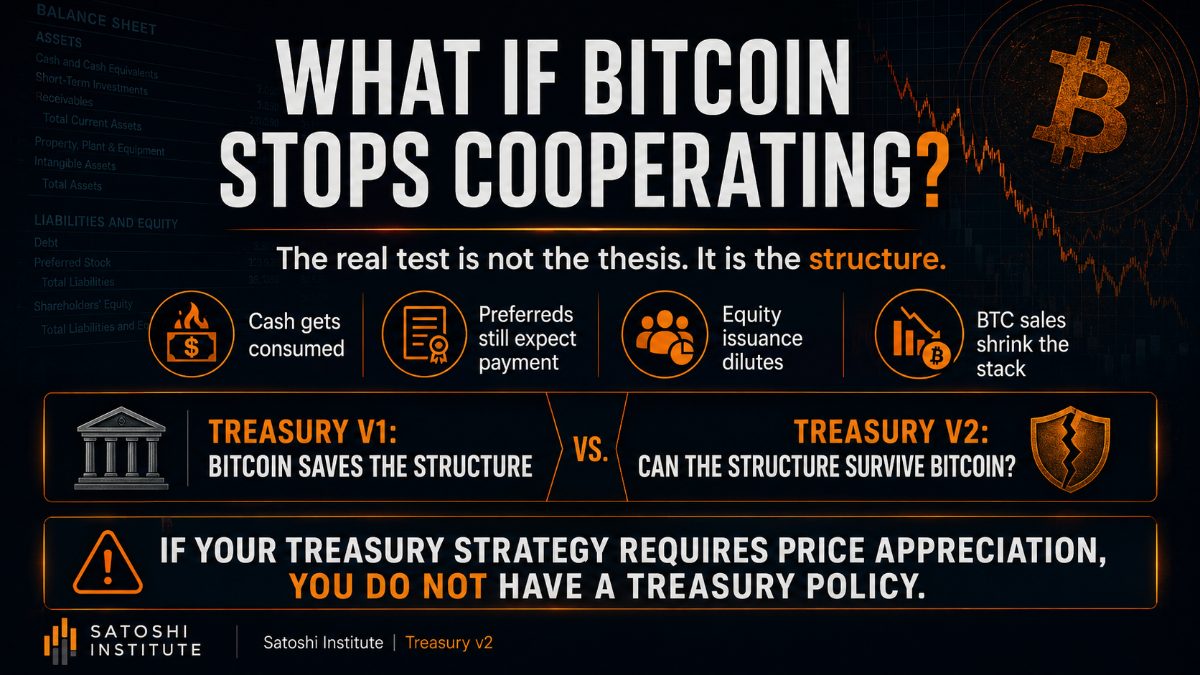
Cash becomes more important. Buybacks compete with accumulation. Common issuance dilutes. Bitcoin sales preserve liquidity but shrink the stack.
That does not mean Strategy is broken. It means the model has matured beyond "buy and hold."
Treasury v2 does not ask whether Bitcoin eventually goes higher.
It asks whether the company can remain solvent, liquid, and governable while waiting.