
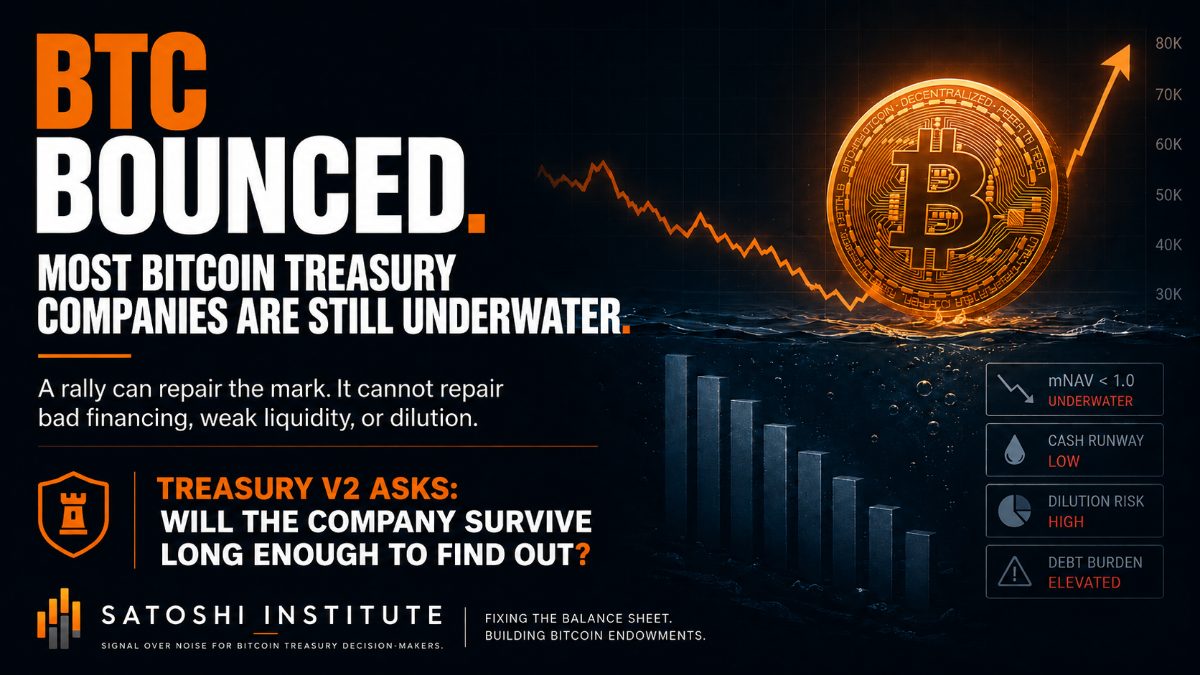
Bitcoin bounced. Most treasury companies are still underwater.
Bitcoin bounced. Most treasury companies are still underwater.
Daily Perspective
Bitcoin rallied after the U.S. Treasury expanded its debt-buyback program, easing pressure on long-duration yields and helping risk assets catch a bid.
That will generate the predictable celebration.
But one headline should make treasury boards considerably less comfortable: roughly 80% of public Bitcoin treasuries are reportedly still underwater.
A rising Bitcoin price can improve the marks.
It cannot undo expensive financing, dilution, poor entry prices, conditional funding, or a weak operating model.
The market just offered the sector a little oxygen. That is not the same thing as repairing the lungs.
The Day’s Signals
1. Treasury liquidity helped Bitcoin. That is worth noticing.
The U.S. Treasury reportedly increased its longer-duration debt buybacks, which eased pressure in the bond market. Bitcoin responded sharply, reaching its highest levels in roughly 11 weeks as short positions were liquidated.
This is another reminder that Bitcoin now trades inside the broader capital system.
Liquidity conditions matter. Yields matter. Government debt management matters.
For corporate treasuries, that means Bitcoin cannot be governed as though its price is disconnected from the financing environment surrounding the company.
A favorable macro move can lift BTC.
It can also disappear.
2. About 80% of public Bitcoin treasuries are reportedly underwater
This is today's more useful number.
If roughly four out of five public Bitcoin treasury companies are below their Bitcoin acquisition cost, the sector has moved well beyond the theoretical discussion about drawdowns.
Boards now have actual evidence of what prolonged weakness does to the model.
Some companies can simply wait.
Others cannot.
Their ability to wait depends on cash, debt, preferred obligations, operating losses, collateral arrangements, and access to new capital.
The Bitcoin may be identical.
The ability to survive the drawdown is not.
3. New adoption has not disappeared
Zhibao Technology reportedly completed a $154.7 million Bitcoin-funded private placement, establishing a corporate Bitcoin treasury.
That is important because the recent narrative has been that new treasury adoption has largely stalled. There are still entrants. But this new cohort is arriving after the market has already demonstrated what can go wrong.
That should change the standard.
A 2026 treasury adopter has far less excuse than a 2020 adopter for failing to define liquidity limits, dilution policy, downside scenarios, and operating purpose before buying.
We have case studies now. Quite a few of them.
4. Metaplanet is building another treasury vehicle, but the funding is conditional
Metaplanet's proposed U.S. expansion through Superplanet begins with 2,100 BTC and control of the underlying public company. Reports suggest the structure could eventually unlock more than $3 billion in additional financing, but much of that capital remains conditional.
That word matters.
"Potential funding" is not liquidity.
Nor is a large financing authorization the same thing as capital available on acceptable terms.
Treasury v2 should separate authorized capital, committed capital, accessible capital, and capital that remains economically sensible after dilution and financing costs.
Otherwise, a very large number on a slide can acquire an impressive amount of authority it has not yet earned.
5. Treasury equities remain more fragile than Bitcoin itself
Bitcoin strengthened while corporate treasury equities have remained under substantial pressure.
That divergence is exactly what investors should expect once the corporate wrapper becomes complicated.
A treasury company carries Bitcoin exposure plus whatever management has built around it: debt, dilution, preferred securities, operating costs, financing requirements, and execution risk.
When Bitcoin rises, some of those structures amplify the upside.
When capital gets expensive, they can amplify something else.
What This Actually Means
Today's rally does not invalidate the problems exposed during the drawdown. It makes them easier to see.
If 80% of treasury companies remain underwater after Bitcoin rebounds, the market is telling us that owning the right asset does not automatically produce the right corporate outcome.
Some companies bought too aggressively. Some financed badly. Some diluted faster than they accumulated. Some built structures that require continued access to capital. And some may be perfectly capable of waiting for the Bitcoin thesis to recover.
That distinction is Treasury v2.
The next useful ranking of Bitcoin treasury companies should not ask who holds the most BTC.
It should ask:
Who can afford to wait?