
A Rally Is Not a Governance Model
A Rally Is Not a Governance Model
Daily Perspective
Bitcoin has rediscovered one of its favorite talents: making everyone forget what they were worried about two weeks ago.
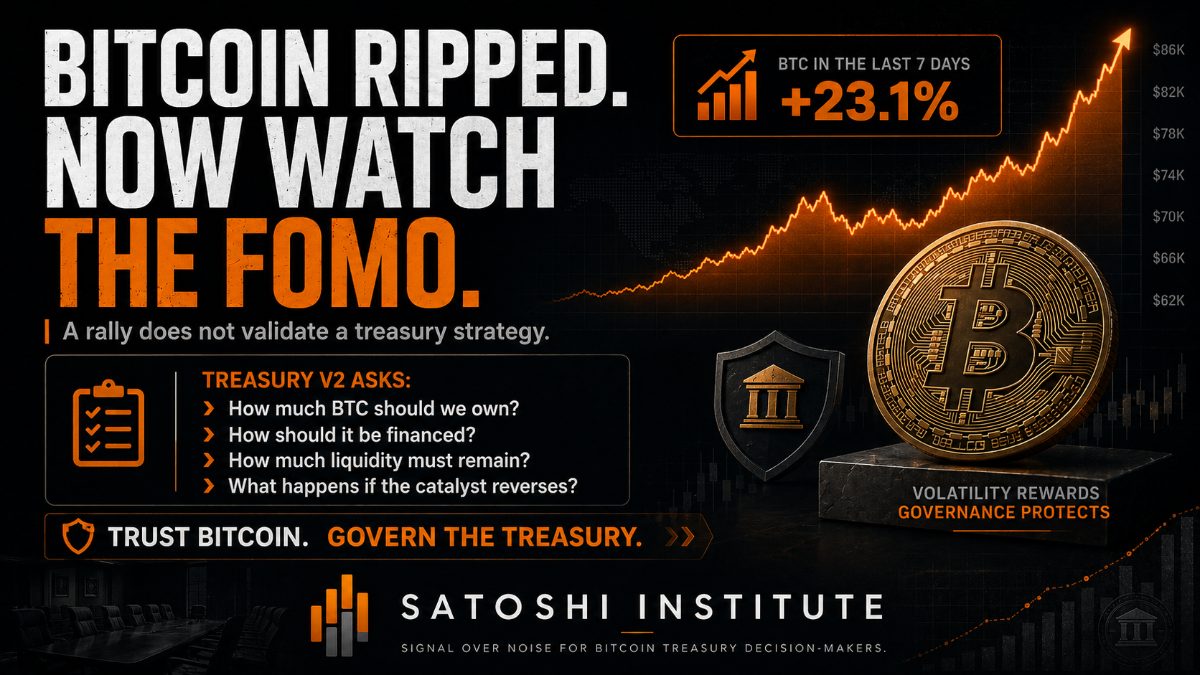
After a roughly 20%+ weekly advance, renewed ETF inflows, and Bitcoin briefly moving above $80,000, the conversation has predictably swung back toward the bull case.
But the more important treasury story is happening underneath the price.
Strategy accumulated cash instead of Bitcoin. Strive accumulated Bitcoin. Metaplanet moved coins through institutional custody infrastructure. Meanwhile, the macro catalyst helping lift Bitcoin came partly from intervention in the Treasury market itself.
Different companies. Different decisions. Same underlying question:
What is the best use of treasury capital right now?
That is a much more mature question than simply asking who bought the most Bitcoin.
Signals We’re Watching
1. Bitcoin rallied. Institutional demand returned with it.
Bitcoin climbed roughly 23% over seven days and briefly traded above $80,000, while U.S. spot Bitcoin ETFs recorded their strongest weekly inflows in roughly ten months.
BlackRock's IBIT accounted for a substantial portion of those flows, while broader crypto markets also benefited from a major short squeeze.
Why it matters: A stronger market improves treasury economics, financing conditions, and investor sentiment. It does not eliminate leverage, dilution, liquidity, or concentration risk.
A rising Bitcoin price can repair a balance sheet.
It cannot redesign one.
2. The U.S. Treasury may have helped light the fuse.
The U.S. Treasury increased its purchases of longer-duration government debt as policymakers attempted to address elevated long-term yields. Bitcoin, gold, and silver all rallied as the dollar weakened and markets reconsidered future liquidity conditions.
Some commentators have already framed the move as the beginning of another major liquidity cycle.
Perhaps.
But a treasury strategy that only works when macro liquidity is improving is not particularly resilient. It is merely well-timed.
Why it matters: Bitcoin treasury companies increasingly operate inside the same macroeconomic system Bitcoin was supposed to sit outside of. Interest rates, dollar liquidity, credit markets, and government intervention now directly affect their financing options.
3. Strategy chose cash while Bitcoin rallied.
Strategy reported no Bitcoin purchases during the latest reporting period.
Instead, it established approximately $1.59 billion of flexible USD liquidity, separate from its restricted reserve. Combined with its other designated cash reserves, the company now has billions of dollars available for obligations, repurchases, future Bitcoin purchases, and other capital actions.
This is far more interesting than another Bitcoin purchase announcement.
Strategy effectively created something Bitcoin treasury companies have historically treated as almost ideologically suspicious:
dry powder.
Why it matters: Liquidity creates optionality. Optionality allows management to choose when to deploy capital instead of being forced to raise it when markets are least accommodating.
That is Treasury v2 behavior.
4. Strive made the opposite decision. It bought.
Strive acquired approximately 1,110 BTC for $81.5 million, increasing its holdings to more than 21,000 BTC.
The decision is not inherently more aggressive or less sophisticated than Strategy's decision to hold cash.
The important question is whether the purchase fits the company's financing structure, obligations, liquidity position, and shareholder economics.
Why it matters: Treasury v2 does not say "do not buy Bitcoin."
It says buying Bitcoin must compete against every other available use of capital.
That distinction matters.
5. Metaplanet's Bitcoin movement became a custody story.
Metaplanet moved approximately 1,000 BTC to Coinbase Prime, with reporting indicating the transaction was related to custody management rather than a sale.
That may sound operational.
For a multibillion-dollar corporate Bitcoin position, it is not.
Custody architecture determines who can authorize transfers, how assets are segregated, what counterparties exist, what collateral rights may apply, and what happens during a failure or dispute.
Why it matters: Once Bitcoin becomes a material corporate asset, custody stops being a wallet decision.
It becomes governance infrastructure.
What This Actually Means
The rally is the least interesting part of today's news. The more consequential development is that Bitcoin treasury companies are beginning to make visibly different capital-allocation decisions.
One company buys Bitcoin. Another builds cash. Another restructures custody. Those decisions cannot be judged by BTC accumulation alone.
The correct question is:
Did management improve the durability of the treasury per unit of shareholder risk?
That is the shift from accumulation to stewardship.
And rallies are exactly when that discipline becomes easiest to forget.