
Strive Just Became the Treasury Model’s Stress Test
Strive Just Became the Treasury Model’s Stress Test
Perspective
Strive is no longer an interesting small Bitcoin treasury company. It is now one of the sector’s most important experiments. After acquiring another 2,822 BTC for roughly $235 million, Strive now holds about 35,595 BTC, putting it ahead of MARA and into fourth place among public corporate Bitcoin holders.
That ranking will get attention.
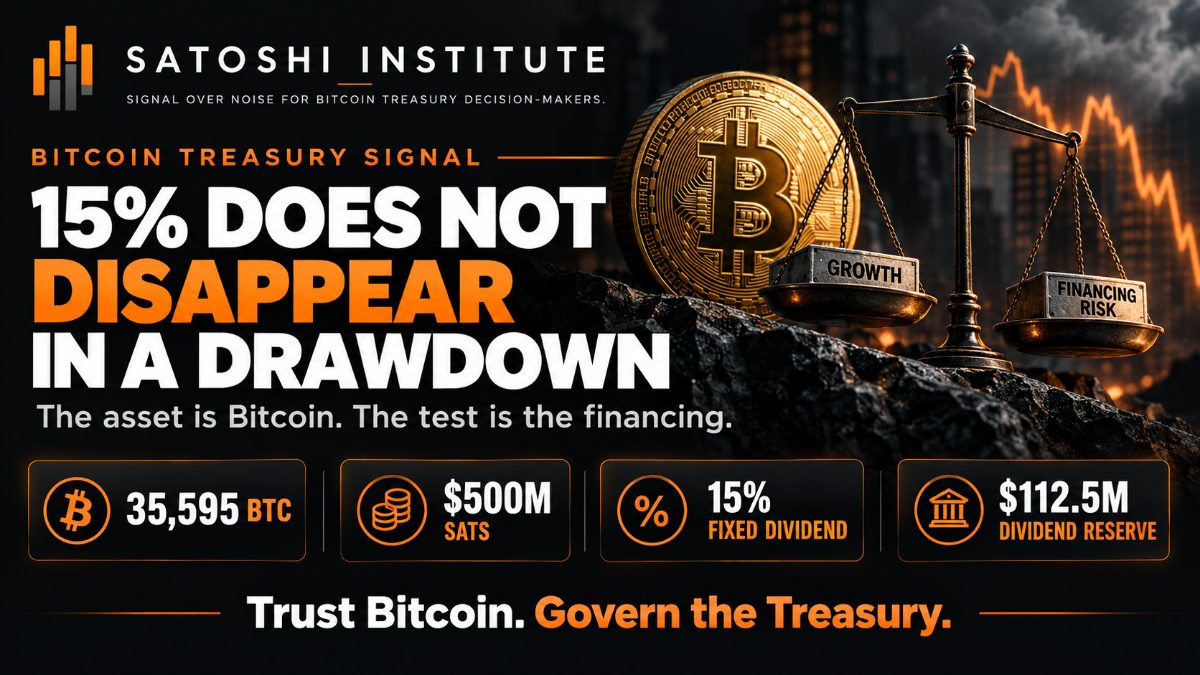
But the more important development is how Strive intends to keep scaling. The company is proposing $500 million of SATS perpetual preferred stock carrying a fixed 15% cumulative dividend, while its existing SATA preferred already pays roughly 13%. The goal is clear: raise capital without issuing additional common stock, buy more Bitcoin or other income-producing assets, and increase amplification for common shareholders.
On paper, that is elegant.
It also creates one of the clearest real-world tests of the Bitcoin treasury model. Can a company use high-cost preferred capital to create enough additional Bitcoin value to justify the permanent claims created around it?
That is no longer a theoretical question. Strive is about to help answer it.
Signals
1. Strive has moved from fast follower to top-four treasury
Strive purchased another 2,822 BTC for approximately $235 million, taking total holdings to about 35,595 BTC. That puts it slightly ahead of MARA’s roughly 35,577 BTC and behind only Strategy, Metaplanet and Twenty One Capital in the current public-company rankings.
The financing behind the move is just as important. Strive reported that 13.7 million of its final 15.3 million warrants were exercised, generating approximately $369 million gross. That means a meaningful portion of its recent growth came from converting an existing equity overhang into capital rather than simply opening another common-share ATM.
The warrant overhang is now largely gone. The question is what replaces it. The answer appears to be preferred capital.
2. SATS turns Strive into a very expensive financing experiment
Strive’s proposed SATS offering would issue 5 million perpetual preferred shares at a stated value of $100 each, targeting roughly $500 million gross.
The fixed cumulative dividend is approximately 15% annually, with distributions expected every business day, subject to declaration. The structure also includes an approximately 18-month dividend reserve of roughly $112.5 million, or $22.50 per preferred share, at closing.
That reserve matters because it gives SATS an immediate liquidity cushion. But it does not change the long-run economics. At full size, a 15% coupon means the company accepts a very high hurdle rate to protect common shareholders from immediate dilution.
That trade can work brilliantly if Bitcoin appreciates enough and the company can deploy capital accretively. It looks very different if Bitcoin falls, mNAV compresses and access to new capital becomes more difficult.
3. The real debate is shifting from amplification to survivability
The bullish case for Strive is straightforward.
More preferred capital means more Bitcoin can be acquired without issuing additional ASST common. If Bitcoin rises, common shareholders receive more upside against a relatively fixed preferred claim. That is the amplification argument.
The bearish case is equally straightforward. Preferred dividends do not disappear when Bitcoin falls.
A stress scenario circulating this week models a roughly 33% Bitcoin decline over three years, continued 13–15% preferred distributions, and no access to fresh capital. Under those assumptions, the common-equity cushion could erode dramatically.
The exact numbers depend heavily on the assumptions, and the scenario is not a prediction.
But the question it raises is legitimate: How much fixed financing cost can a Bitcoin treasury safely carry through a prolonged drawdown?
That is becoming more important than the ranking table.
What It Means
Strive has become an unusually useful case study because the company is attempting to solve the core problem confronting the second generation of Bitcoin treasury companies.
Common equity is dilutive. Debt creates repayment risk. Preferred equity protects the common denominator, but introduces expensive recurring claims.
There is no free financing structure.
Strive’s wager is that 15% preferred capital can still be accretive if it creates enough additional Bitcoin exposure and if the company can keep refinancing, raising capital and managing distributions through the cycle.
If that works, SATS could become an important template for the sector. If it does not, it may demonstrate the limits of using high-yield preferred capital to manufacture Bitcoin amplification.
That is why today’s most important number is not 35,595 BTC. It is 15%.
The ranking tells us how large Strive has become. The coupon may tell us how durable the model is.
Bitcoin is the asset. The real experiment is whether the financing survives the cycle.
Trust Bitcoin. Govern the Treasury.