
Corporate Bitcoin adoption is often reduced to a number.
How many public companies hold Bitcoin?
How much Bitcoin do they own?
Who bought this week?
Who moved up the leaderboard?
Those questions are useful, but the data model behind them contains an important weakness.
Companies are usually easy to notice when they enter.
They are much easier to miss when they leave.
That creates a survivorship-bias problem for corporate Bitcoin research.
If companies are added when they announce a Bitcoin purchase but are not updated with equal discipline when they reduce, suspend, liquidate or abandon the strategy, the dataset gradually stops describing reality.
The problem is not simply that a few rows become stale.
The entire picture of corporate Bitcoin adoption becomes distorted.
Adoption Is a Lifecycle, Not a Leaderboard
Most corporate Bitcoin trackers are naturally organized around current holdings.
That structure makes sense.
Investors want to know who owns Bitcoin and how much.
But a current-holdings table is not the same thing as a corporate-adoption dataset.
A company can move through several distinct stages:
Adopt → Accumulate → Hold → Reduce → Monetize → Suspend → Exit → Re-enter
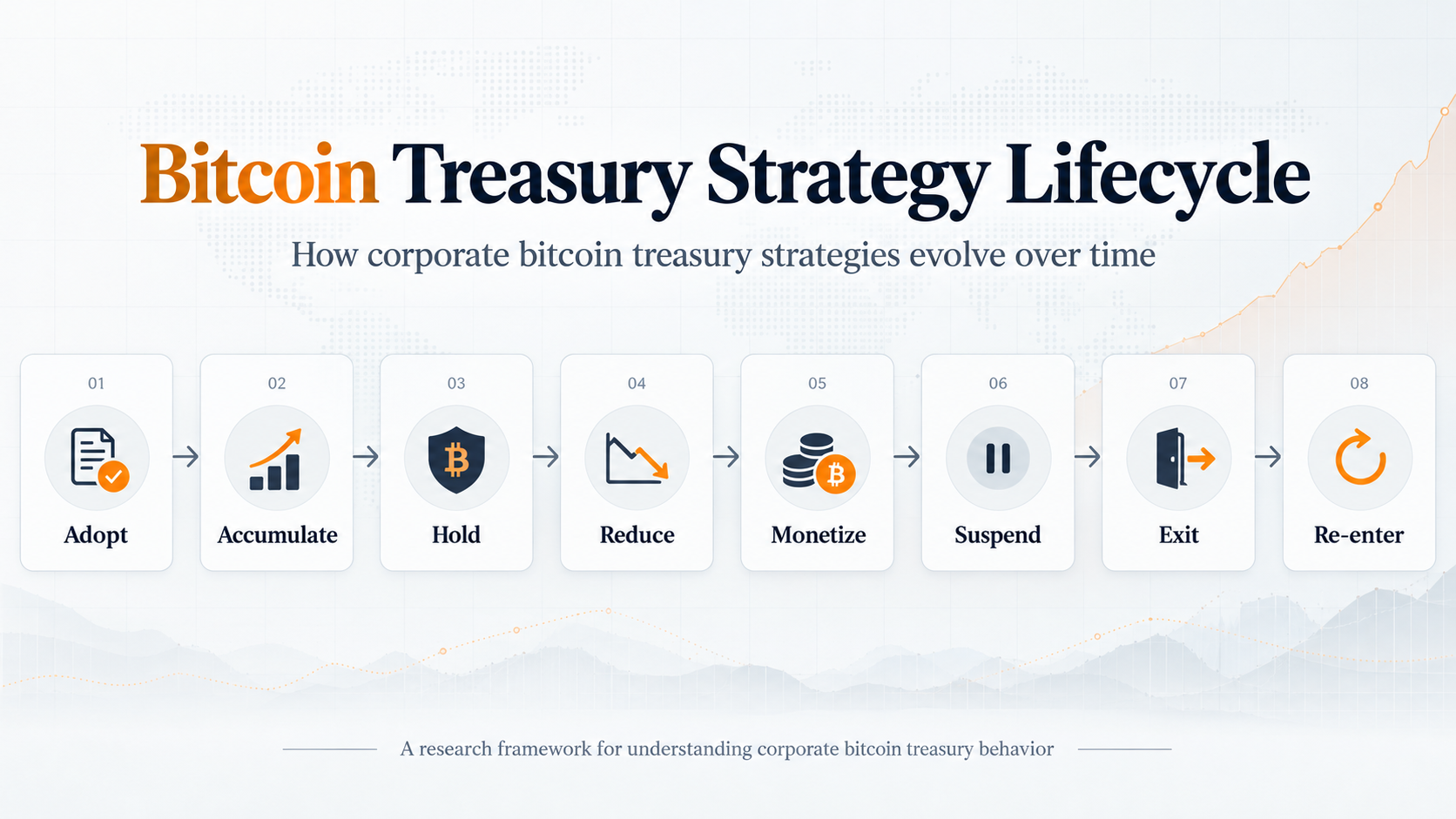
Those transitions matter.
A company that holds 500 BTC while actively accumulating is in a different strategic state from a company holding 500 BTC after formally suspending future purchases.
A company with 200 BTC remaining after selling Bitcoin to repay debt is different from a company deliberately maintaining a 200 BTC long-term reserve.
A company whose board has authorized complete liquidation is different from one that merely has not purchased recently.
And a company at zero Bitcoin because it completed an exit is different from a company for which the latest balance is simply unknown.
A leaderboard usually cannot express those distinctions.
Why Missing Exits Matter
Suppose a database records 100 companies that adopted Bitcoin.
Over time, ten abandon their strategies.
If the exits are correctly recorded, the dataset can answer several useful questions:
- 100 companies adopted.
- 90 remain active.
- 10 fully exited.
- The exit rate is 10 percent.
- The median duration before exit can be calculated.
- Exit reasons can be compared.
- Financing structure among survivors and exits can be studied.
If the exited companies simply disappear, the historical denominator disappears with them.
The database now shows 90 companies.
It cannot tell us that 100 once adopted.
It cannot calculate an exit rate.
It cannot compare survivors with exits.
It cannot tell us how durable corporate adoption has been.
The missing exits eliminate the denominator required for serious analysis.
That is survivorship bias.
Stale Holdings Create a Different Distortion
The opposite problem occurs when an exited company is not removed from current holdings.
Then the company remains visible as an active holder even after primary-source evidence says otherwise.
Total corporate Bitcoin holdings are overstated.
The number of active treasury companies is overstated.
Strategy persistence is overstated.
The industry appears more durable than the evidence supports.
This is particularly problematic because aggregate numbers often look authoritative.
A number such as "public companies hold X Bitcoin" appears precise.
But precision in the total does not guarantee accuracy in the underlying records.
A number without provenance creates false confidence.
Every aggregate should inherit the quality of the underlying records.
What the Exit Cases Show
The recent corporate exits illustrate why a binary holder/non-holder model is inadequate.
Prenetics moved through several distinct stages. It launched an aggressive Bitcoin treasury strategy in June 2025, later stopped further acquisitions, authorized full divestment in May 2026, completed the sale, and adopted a policy against future Bitcoin and digital-asset purchases. Initial SEC filing and May 2026 filing
Sequans reduced Bitcoin first to repay debt, later stated that it was no longer pursuing the digital-asset treasury strategy while still holding Bitcoin, and only months later sold the final position. November 2025 filing, May 2026 filing, and September 2026 filing
Satsuma reached the liquidation process through shareholder action. Authorization and execution occurred at different points.
Bitdeer fully liquidated its BTC treasury even though its operating business remained exposed to Bitcoin. Form 20-F
Genius Group demonstrates that an exit can be temporary or constrained by financing and legal circumstances. SEC filing
Vaultz demonstrates that a company can formally change the strategy while still retaining Bitcoin. FCA announcement
These are not edge cases.
They expose a weakness in the data model.
Exits Are Data, Not Deletions
When a company exits Bitcoin, the historical record should not disappear.
The company should remain in the dataset.
Its status should change.
That is a subtle but important difference.
Deleting an exited company preserves the appearance of a clean current leaderboard but destroys the historical information required to study adoption.
A better model retains the issuer and records the transition.
For example:
| Date | Company | BTC | Treasury State |
|---|---|---|---|
| June 2025 | Example Corp. | 200 | Accumulating |
| October 2025 | Example Corp. | 500 | Accumulating |
| December 2025 | Example Corp. | 500 | Purchases Suspended |
| March 2026 | Example Corp. | 300 | Reducing |
| May 2026 | Example Corp. | 0 | Fully Exited |
The final row does not invalidate the earlier rows.
It gives them meaning.
Exits are data, not deletions.
Holdings and Strategy State Must Be Separate
This leads to another important design principle.
Bitcoin holdings and Bitcoin treasury strategy are separate variables.
A company can hold Bitcoin after the strategy has been withdrawn.
A company can reduce Bitcoin without abandoning the strategy.
A company can authorize liquidation before selling anything.
A company can reach zero Bitcoin because of a completed exit.
A company can later buy again.
Therefore:
BTC > 0 does not necessarily mean an active accumulation strategy.
And:
BTC = 0 does not automatically prove a treasury exit.
Zero could reflect a completed sale, missing evidence, incorrect data or a business model in which Bitcoin is routinely produced and sold.
The lifecycle conclusion therefore needs its own evidence.
The Evidence Record Matters
A research-grade corporate Bitcoin dataset should be able to answer not merely what the number is, but why anyone should trust it.
At a minimum, an important holdings or lifecycle event should preserve:
- the issuer and security,
- Bitcoin balance or change,
- effective date,
- event type,
- lifecycle status,
- primary source,
- source publisher,
- document identifier,
- retrieval timestamp,
- evidence fingerprint,
- verification status,
- reviewer,
- approval status,
- supersession history,
- freshness.
Those fields transform a number into a governed research record.
They also make corrections possible without erasing history.
If an earlier filing is superseded, the record can remain visible while the newer one becomes governing.
That is very different from silently overwriting a spreadsheet cell.
Freshness Is Part of the Data
Corporate treasury information also has a time dimension.
A figure that was verified six months ago may be historically correct and currently unusable.
Those are different judgments.
Datasets should distinguish:
- verified and current,
- verified but aging,
- verified but stale,
- company reported but unverified,
- unknown or withheld.
Freshness should not be hidden.
Nor should a stale figure automatically be replaced with a less reliable scraped number simply because the scraped number is newer.
Source quality and recency must be governed together.
Aggregates Need Confidence
Headline totals create another challenge.
If a dataset contains a mixture of verified figures, stale figures and unverified company-reported balances, a single total can conceal large differences in evidence quality.
A better system should distinguish, at minimum:
Verified current BTC
from
Reported or unverified BTC
and identify stale records that are excluded from the headline aggregate.
The aggregate should inherit the governance quality of its components.
If a company exits, its former position should stop contributing to the current total.
If its current balance cannot be established, the dataset should say so rather than assume the last known number remains true.
Good data should not exist to validate a narrative.
It should make the narrative answer to the evidence.
New Metrics Become Possible
Once companies are tracked as a lifecycle rather than a static list, corporate Bitcoin research becomes much more interesting.
We can measure:
- active treasury companies,
- new adopters,
- full exits,
- partial reductions,
- re-entries,
- median strategy duration,
- annual exit rate,
- reason for exit,
- percentage of exits that used debt financing,
- percentage of survivors that used debt financing,
- frequency of sub-NAV conditions before strategy changes,
- time between suspension and full exit,
- verified current BTC versus stale or unverified BTC.
Those metrics can begin answering questions the current industry discussion cannot.
Do leveraged strategies exit more often?
Do companies with greater non-Bitcoin liquidity survive drawdowns longer?
Does a sustained discount to net asset value predict strategy reduction?
How often does an exit represent a permanent abandonment versus a temporary financing response?
Which governance structures appear most durable?
Those are research questions.
A leaderboard cannot answer them.
The Data Model Changes the Story
There is a broader lesson here.
Data structures shape narratives.
If the database is designed only to record entrants and current holdings, the dominant narrative will naturally be accumulation.
More companies.
More Bitcoin.
More adoption.
But if the same database records reductions, suspensions, liquidations, exits and re-entry, the story becomes more nuanced.
Corporate Bitcoin adoption is still visible.
So is corporate Bitcoin attrition.
That is not negative framing.
It is measurement.
Markets mature when the inconvenient data receives the same attention as the convenient data.
From Bitcoin Counting to Treasury Intelligence
The distinction is ultimately between counting Bitcoin and understanding treasury strategy.
Counting is necessary.
It tells us the size of the position.
Treasury intelligence asks what that position means.
How was it financed? Is the evidence current? What obligations stand ahead of the Bitcoin? Has management changed the policy? Has the company sold? Why? Is the strategy still active? Did shareholders intervene? Has the company exited? Did it later return?
Those questions require longitudinal data.
They require provenance.
They require governance.
And they require us to keep the exits.
If corporate Bitcoin adoption is going to be treated as an institutional financial phenomenon rather than a collection of announcements, the dataset has to preserve the entire lifecycle.
The entrances matter.
So do the exits.
Continue the Series
Previous: Part II: Bitcoin Treasury Strategies Rarely Fail Because of Bitcoin
Start the series: Part I: When the Bitcoin Treasury Strategy Ends
Series: When Bitcoin Treasury Strategies Break
From Research to Data
This research is informing the evolution of Satoshi Analytics from a current-holdings tracker toward a governed corporate Bitcoin treasury research platform.
The objective is not merely to answer how much Bitcoin does a company own?
It is to answer:
How durable is the company's Bitcoin treasury strategy, and what happens to it over time?
Satoshi Institute. Bitcoin treasury governance for the next stage of corporate adoption.