
September Has a Reputation. Your Treasury Should Have a Policy.
September Has a Reputation. Your Treasury Should Have a Policy.
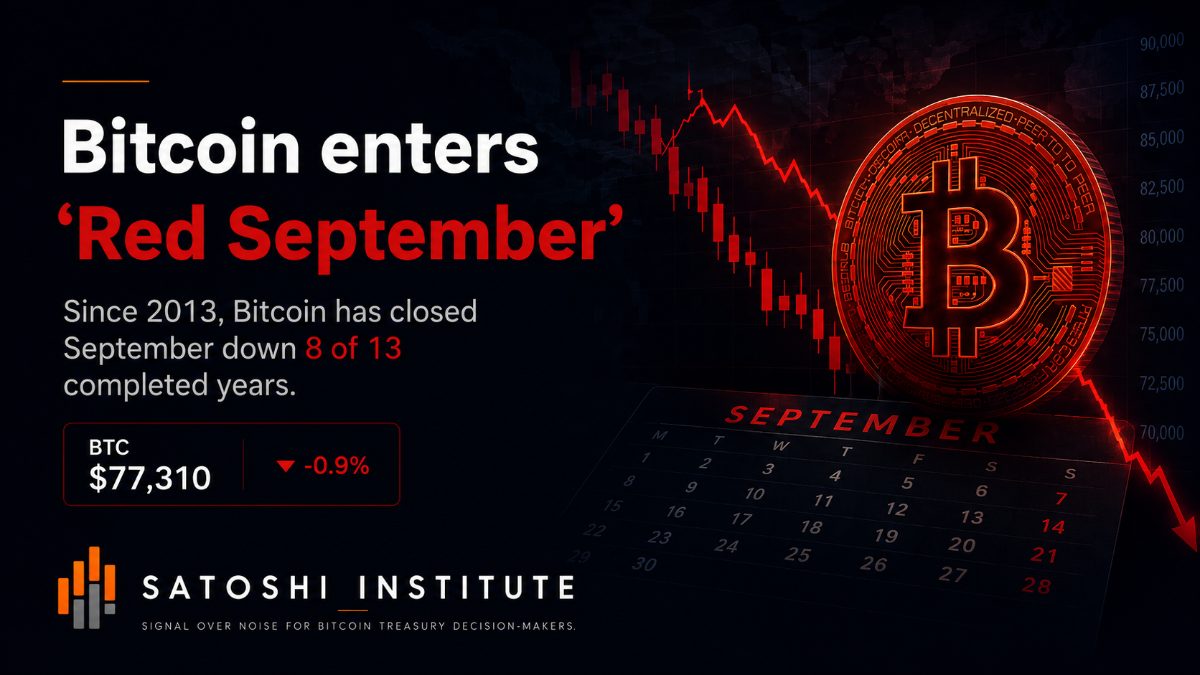
Daily Perspective
Bitcoin just finished its strongest August since 2021, gaining nearly 25%.
Naturally, the market has responded by dusting off one of its favorite September traditions: deciding that the calendar itself may now be a risk factor.
Since 2013, Bitcoin has finished September lower in eight of 13 completed years. That is enough history to generate a catchy phrase. It is not enough to run a treasury.
Bitcoin has started the month softer, trading around $77,000 after briefly moving above $80,000. The market will now spend the next several weeks debating whether “Red September” is destiny, coincidence, positioning, macro pressure, or merely another story traders tell themselves when price action becomes uncomfortable.
Boards have a simpler job.
They do not need to predict September. They need to know what the treasury does if September turns red.
1. Bitcoin enters September with history working against sentiment
Bitcoin has closed September lower in eight of the last 13 completed years, and the month has begun with BTC retreating from recent highs above $80,000 toward roughly $77,000.
The seasonal pattern gets attention because it is easy to understand. But neither Bitcoin nor a corporate treasury operates on superstition. A board-approved treasury process should not materially change because the calendar moved from August to September.
Governance signal
Seasonality may belong in a risk discussion. It should not substitute for a trigger, threshold, or policy.
The right question is not:
“Is September usually bad for Bitcoin?”
It is:
“What drawdown, liquidity, or financing condition would actually require us to act?”
2. Strategy’s preferred financing shows why price is only one variable
Strategy continues to manage STRC around its $100 par objective while maintaining a 12% dividend rate, illustrating the growing importance of the financing structures wrapped around its Bitcoin strategy. The current news set also highlights ongoing questions around preferred costs, buybacks, reserve support, and capital-market execution.
This is where the Treasury v2 discussion becomes more interesting than the Bitcoin chart.
A declining BTC price is one risk. A high-cost preferred security is another. A company that finances Bitcoin through instruments carrying cash obligations has to manage both at once.
Governance signal
A treasury should stress Bitcoin price and the cost of maintaining the capital structure that financed it.
A 20% BTC drawdown means something very different when the company has no material cash obligations than when it has debt service, preferred dividends, or refinancing pressure attached.
3. Strive continues buying while sector conviction becomes less uniform
Recent reporting indicates Strive has continued purchasing Bitcoin through its SATA financing structure even as demand across the broader treasury sector has become less consistent.
This reinforces a theme that has become increasingly visible:
Treasury companies exposed to the same Bitcoin price are not making the same decisions.
- Some buy.
- Some pause.
- Some raise capital.
- Some sell.
- Some restructure.
The difference is not Bitcoin. It is the balance sheet surrounding it.
Governance signal
The market price is common. The treasury constraints are not.
4. Strategy continues challenging MSCI over index treatment
Strategy is pushing back against an MSCI proposal that could change index treatment for companies with very large Bitcoin treasury exposures. This remains an underappreciated governance issue. A treasury strategy can influence much more than asset allocation.
It can eventually affect:
- index eligibility,
- passive ownership,
- cost of equity,
- investor composition,
- liquidity,
- and valuation.
That means the treasury strategy itself can begin altering the capital-market ecosystem in which the company operates.
Governance signal
Bitcoin exposure is no longer only an asset-side decision.
At sufficient scale, it can alter the characteristics of the security itself.
What This Actually Means
“Red September” is useful mostly because it exposes a governance mistake.
A company should never need a market narrative to tell it what to do. If Bitcoin falls 10%, management should already know whether that matters. If it falls 25%, management should already know whether that crosses a threshold. If financing costs rise, the company should already know whether preferred issuance remains acceptable. If mNAV compresses, management should already know whether issuing common equity remains accretive. If liquidity falls below a minimum runway, management should already know whether accumulation pauses.
That is the difference between a treasury strategy and a treasury reaction.
The fanboy version of September sounds like:
“Buy the dip.”
The fearful version sounds like:
“September is always terrible.”
A governed treasury needs neither. It needs rules. That is the institutional upgrade.