
The Bitcoin Treasury Trade Is Becoming a Financing Trade
The Bitcoin Treasury Trade Is Becoming a Financing Trade
Perspective
The Bitcoin treasury market is becoming less about buying Bitcoin and more about figuring out how to finance, defend, and optimize the Bitcoin already on the balance sheet.
That shift is visible across the three strongest signals today.
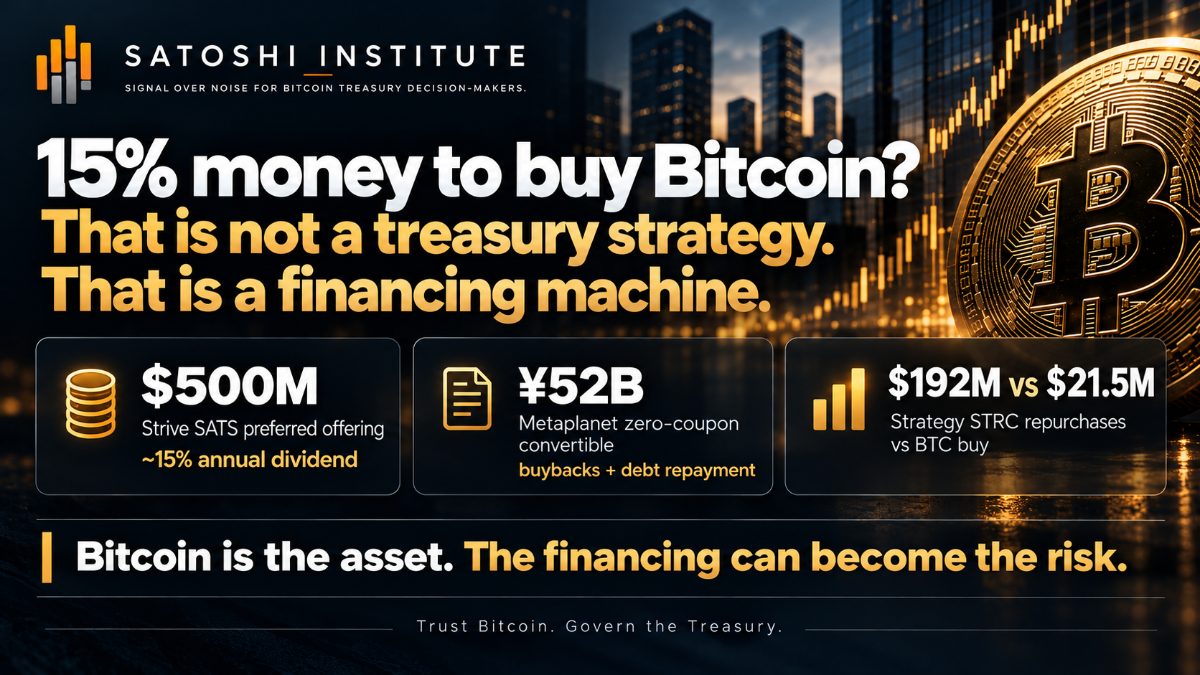
Strive is proposing a $500 million perpetual preferred offering carrying roughly a 15% annual dividend. Metaplanet is raising approximately ¥52 billion, or about $329 million, through a zero-coupon convertible, but the money is being directed toward repaying Bitcoin-backed loans and buying back shares rather than purchasing more Bitcoin. Strategy, meanwhile, added only 250 BTC while deploying about $192 million toward STRC repurchases.
The old playbook was relatively simple: issue securities, buy Bitcoin, increase the stack.
The new playbook is more complicated. Companies are asking which security to issue, what that capital costs, whether common shares should be repurchased, how much leverage belongs on the balance sheet, and whether additional Bitcoin is even the best use of the next dollar.
That is a more mature market.
It is also a market where bad financing decisions can matter as much as bad Bitcoin decisions.
Signals
1. Strive is offering $500 million of preferred capital at roughly 15%
Strive has proposed a $500 million perpetual preferred stock offering, expected to trade under the ticker SATS, with an indicated annual dividend around 15%.
The company recently added 3,311 BTC, taking its holdings to roughly 32,773 BTC, and the new preferred capital could support additional Bitcoin purchases and Bitcoin-related activity.
The interesting number, however, is not $500 million. It is 15%. That is expensive capital.
If the preferred is issued successfully, Strive gains another route to finance Bitcoin without immediately issuing more common equity. But a perpetual 15% obligation creates a very different economic hurdle than a common-stock ATM during periods when the equity trades at a substantial premium.
The question becomes whether the Bitcoin acquired with that capital can generate enough long-term economic value to justify the financing burden attached to it.
Preferred capital may protect the common-share denominator. It does not make the financing free.
2. Metaplanet is borrowing to improve the structure, not enlarge the stack
Metaplanet is issuing approximately ¥52 billion, or roughly $329 million, of zero-coupon convertible bonds due in 2031.
The use of proceeds is revealing. Approximately $149 million is expected to repay Bitcoin-backed borrowing, while roughly $179 million is earmarked for share repurchases.
None of that is primarily about buying additional Bitcoin.
Metaplanet already holds about 44,000 BTC. Its current priority appears to be reducing collateralized borrowing, tightening the equity structure, and potentially improving BTC per share through buybacks.
That is a meaningful evolution.
A company can increase the economic value of its Bitcoin position without increasing the number of Bitcoin it owns. Sometimes the better trade is not adding to the numerator. It is improving the denominator and reducing the liabilities around it.
3. Strategy is showing what happens when mNAV stops doing the heavy lifting
Strategy purchased another 250 BTC for roughly $21.5 million, bringing holdings to approximately 848,250 BTC. At the same time, it spent about $192 million repurchasing STRC.
That contrast says a great deal about where the treasury model is heading.
When mNAV premiums are high, common-equity issuance can be an extraordinarily effective mechanism for expanding Bitcoin holdings while potentially increasing BTC per share.
When those premiums compress toward or below 1x, that mechanism becomes much less attractive. The market then forces management to consider different tools: preferred issuance, preferred repurchases, convertibles, common-share buybacks, cash reserves, and slower accumulation.
The treasury strategy has not disappeared. The financing environment has changed.
What It Means
Bitcoin treasury companies are entering a phase where cost of capital may matter more than speed of accumulation.
Strive is testing whether investors will finance Bitcoin exposure at roughly 15%. Metaplanet is using zero-cost debt to reduce Bitcoin-backed borrowing and repurchase equity. Strategy is spending almost nine times more on preferred repurchases than on new Bitcoin.
Those are not three versions of the same accumulation trade. They are three different answers to the same question: How do you create shareholder value when simply issuing common stock and buying more Bitcoin is no longer obviously accretive?
That is the market to watch now. The winners will not necessarily be the companies that buy the most Bitcoin. They may be the companies that can fund it most efficiently, service the obligations around it, protect BTC per share, and know when another use of capital is better.
Bitcoin is still the asset. The cost of capital is becoming the constraint.
Trust Bitcoin. Govern the Treasury.