
The Bitcoin May Be the Same. The Wrapper Is Becoming the Strategy.
The Bitcoin May Be the Same. The Wrapper Is Becoming the Strategy.
Why Today Matters
Bitcoin is back above $80,000. Treasury stocks rallied with it. Strategy jumped sharply. Capital B raised more money. Metaplanet keeps accumulating.
The accumulation crowd can safely return to its natural habitat.
But underneath the renewed enthusiasm, something more consequential is happening.
Strive’s SATA and Strategy’s STRC are competing not on Bitcoin itself, but on how investors are paid to finance Bitcoin accumulation. SATA offers a daily-distributed 13% coupon. STRC currently offers 12% with monthly distributions. The emerging argument is that frequency, simplicity and investor experience may matter as much as headline yield.
That sounds like a product-marketing story.
It is actually a capital-structure story.
Once Bitcoin treasury companies depend on recurring access to investor capital, the design of the security funding the treasury becomes part of the treasury strategy itself.
Signals We’re Watching
1. SATA versus STRC: capital is becoming a product market
The most interesting discussion in the current Bitcoin treasury market may be happening one layer above Bitcoin.
Strive’s SATA is reportedly attracting attention with a 13% annual coupon distributed daily, while Strategy’s STRC currently carries a 12% annual dividend paid monthly.
The difference appears small if we look only at yield. It may be much larger if we look at investor behavior. Daily distributions create immediacy. They make the income visible. They reduce the psychological distance between purchasing the security and receiving the benefit. And in a retail market, frequency can become part of the product.
Governance signal
Treasury financing is no longer simply:
“Can we raise capital?”
It is increasingly:
“Can we design capital investors want to own repeatedly, at an economically sustainable cost to the enterprise?”
That second half matters. A 13% coupon may attract capital. It is still a 13% obligation.
2. Bitcoin treasury equities are amplifying the Bitcoin move again
Bitcoin’s rebound toward roughly $81,000 was accompanied by substantial moves in crypto treasury equities, including a reported 14% rise in Strategy and gains elsewhere across the sector.
That is the treasury trade behaving as designed.
- Bitcoin rises.
- Net asset value improves.
- Investor enthusiasm returns.
- Equity prices can move even faster.
The danger is interpreting the equity rally as proof that every underlying capital structure is healthy.
It is not.
Equity prices reflect expectations about Bitcoin, future capital access, financing economics, management execution and the market’s willingness to continue paying a premium for the wrapper.
Governance signal
A rising treasury stock can make financing easier.
That financing advantage should be treated as temporary strategic capacity, not a permanent property of the company.
3. Nakamoto offers the other side of the Strategy imitation trade
Recent reporting says Nakamoto Holdings has suffered an approximately 99% decline from its peak valuation and is now attempting to reposition its strategy. The exact percentage will attract attention. The governance lesson is broader.
Strategy’s model has sometimes been summarized as:
- Raise capital.
- Buy Bitcoin.
- Repeat.
That description leaves out the machinery that makes the cycle possible.
- Brand.
- Liquidity.
- Capital-market access.
- Instrument design.
- Shareholder base.
- Execution capability.
- Balance-sheet scale.
- Market credibility.
- Preferred securities.
- Debt management.
- And management’s ability to keep investors willing to fund the next transaction.
Copying the visible behavior without recreating the supporting system is not copying the strategy.
It is copying the press release.
Governance signal
Strategy is not a Bitcoin acquisition formula. It is a capital-markets system.
That distinction may explain much of the divergence now appearing among treasury companies.
What This Actually Means
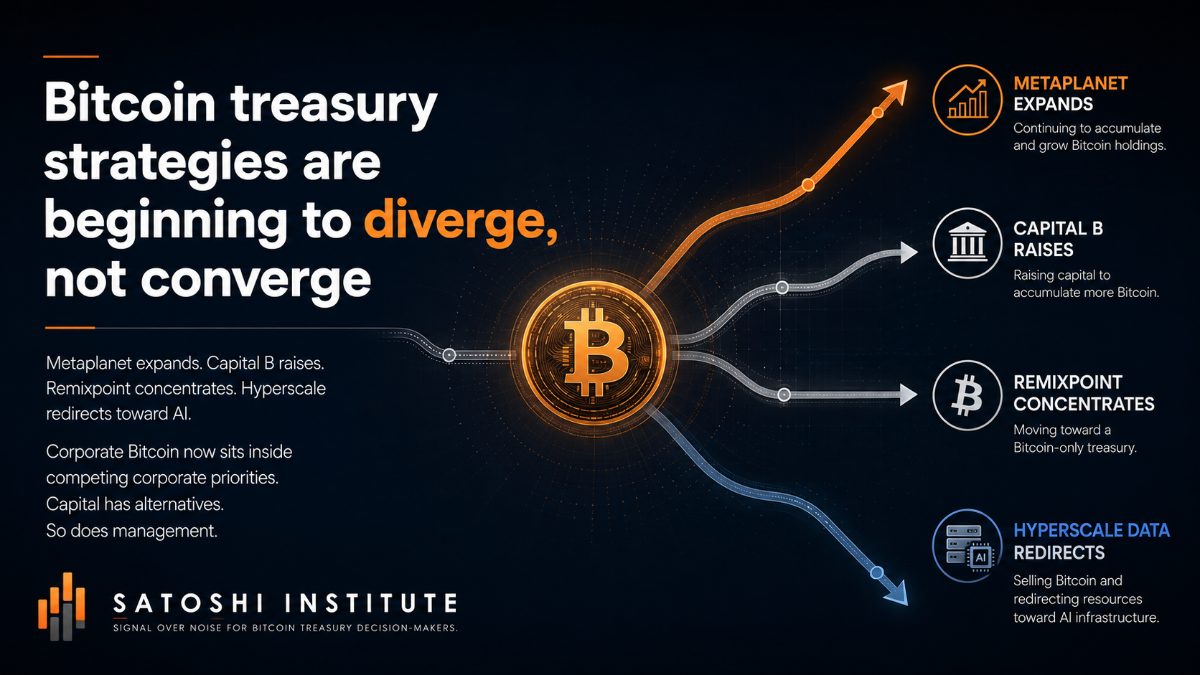
The Bitcoin treasury market is evolving from an asset competition into a capital-structure competition.
At first, differentiation was simple. Who owns the most Bitcoin?
Then the question became: Who can increase Bitcoin per share fastest?
Now another layer is emerging:
Who can build the most durable financing machine around Bitcoin?
That includes the securities investors are willing to buy.
- The yield they demand.
- The frequency with which they are paid.
- The dilution common shareholders accept.
- The capital-market premium management can sustain.
- The liquidity needed to satisfy the resulting obligations.
- And the amount of financial stress the structure can tolerate before Bitcoin itself becomes a source of cash.
This is why SATA versus STRC is more than a retail preference contest.
If one instrument attracts capital more efficiently, it potentially gives the issuer greater capacity to finance the treasury. But that advantage is only valuable if the economics remain sustainable. A security can be extremely attractive to the investor and extremely expensive to the issuer.
Both statements can be true simultaneously. That is where Treasury v2 has to look. Not merely at whether the capital arrived.
But at what the capital costs, what it obligates, and what happens when the market stops providing the next round.